First Lady London
A skincare catalogue renamed out of its regulatory exposure across roughly 950 records, without moving a single URL.
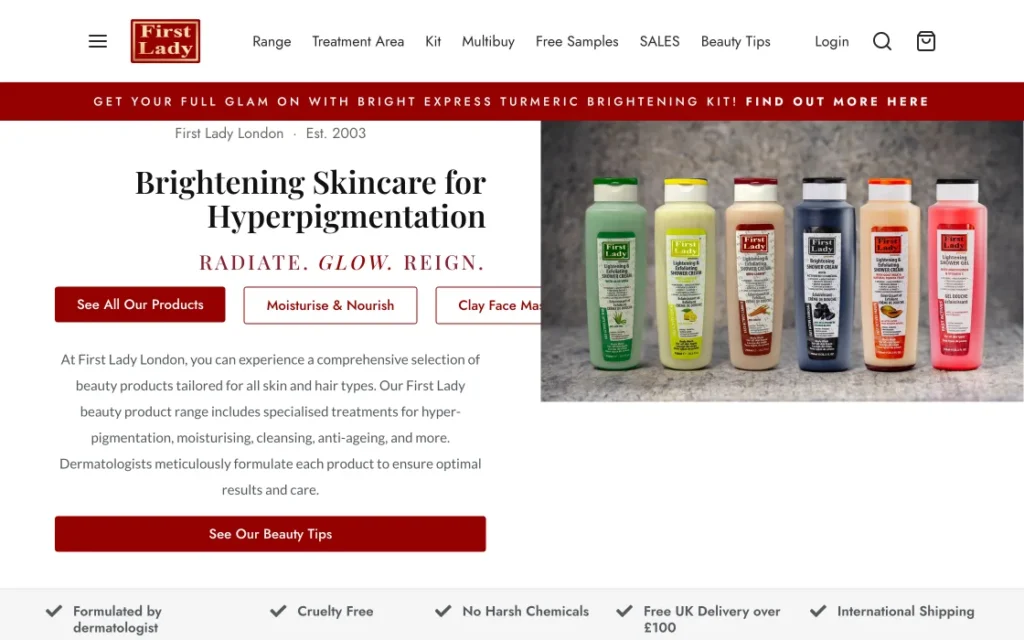
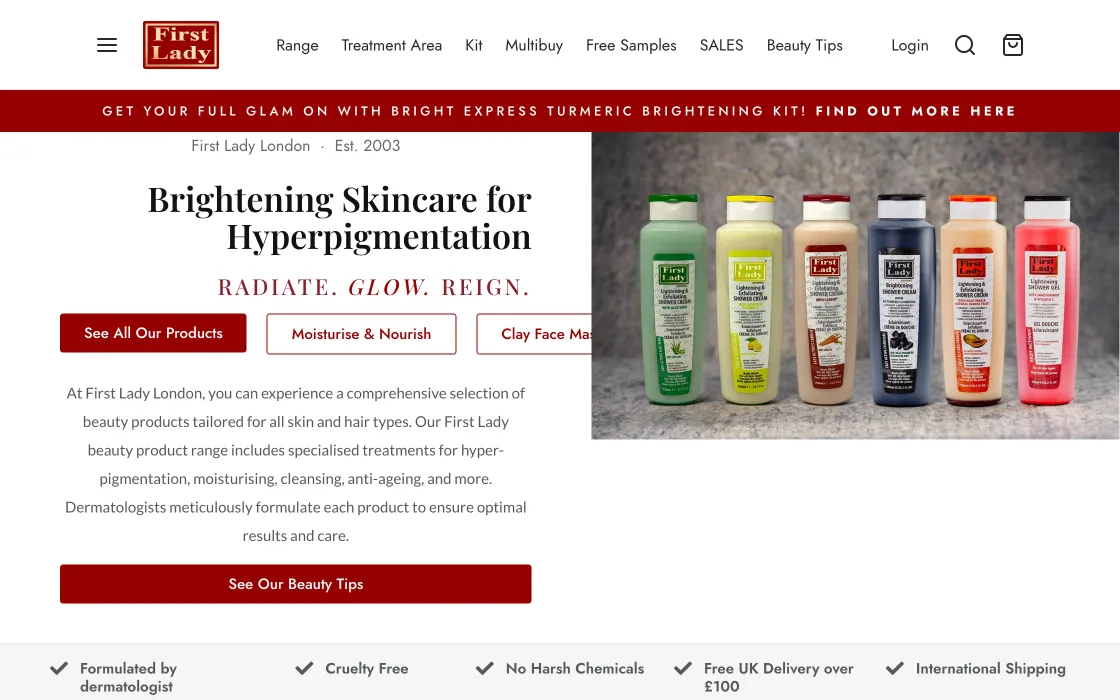
First Lady London: Renaming A Skincare Catalogue Without Losing Its Search Position
The brief
First Lady London has been selling skincare out of London since 2003, shipping to the UK, the EU and the United States. The catalogue runs to more than two hundred published products, across ranges built on kojic acid, glutathione, turmeric and saffron, vitamin C, papaya and AHA.
The problem was the vocabulary. Much of the range had been named, written and optimised around the words “lightening” and “whitening”, and those words had become a liability in two directions at once. Google’s advertising policy has banned ads implying that lighter skin is superior since 2022. UK cosmetics law draws a hard line between a product that changes how skin looks and one that claims to treat a condition, because a product that treats a condition stops being a cosmetic. Individual product pages had drifted over that line, offering to treat acne and hyperpigmentation and naming a medical diagnosis outright.
The words carrying the rankings were the words that had to go.
The work
The rename ran as a single pass over roughly 950 records: product titles and descriptions, blog posts and pages, category and tag names, the main menu, and the SEO titles and descriptions attached to all of them. It had to be one pass rather than a phased rollout, because a half renamed catalogue is worse than either end state. Internal links stop matching the headings they point at, and category names stop matching the products sitting underneath them.
Two decisions were taken with the client before anything moved. URLs and slugs stayed exactly as they were, so nothing needed a redirect and no search equity was spent on the change. And product titles were renamed even where the physical bottle still carries the old word, on the reasoning that the website is what people search, and a catalogue that only half agrees with itself reads worse than one that is simply ahead of its own packaging.
Much of the copy on a site like this does not live in the page content WordPress stores. It lives inside the page builder, held as nested data rather than as text on the post. A find and replace across the obvious fields would have looked complete while leaving every slider, tab and carousel untouched, so the rename walked the entire structure instead.
The claims review was a separate and narrower job. All 215 published products were read for phrasing that promised a medical outcome, or an appearance outcome the business cannot evidence. 44 came back flagged. Most were ordinary marketing language rather than a real problem and were deliberately left alone. 22 were rewritten: treatment claims became language about how skin looks, a named diagnosis came out, and a claim about who formulates the products was brought back to what the company can actually stand behind. Every rewrite was confirmed by exact match count rather than assumed, so nothing could fail quietly.
The technical foundation was already in good order and stayed that way, at 602 live URLs all returning 200, no dead links and no thin pages. The real ceiling sat outside the site altogether. Amazon holds an average position just outside the top ten across 398 keywords this ecommerce catalogue competes for, and no amount of better product copy lifts that. So the content plan moved to where Amazon does not compete: the informational searches about hyperpigmentation itself, where the results are medical and editorial rather than retail.
The result
The catalogue now reads in one vocabulary, from the menu down to the meta description, with no mismatch between a product title, the category above it and the text Google actually displays. The phrases that created the advertising and regulatory exposure are gone from titles, headings, SEO fields and the search plugin’s own cache, re-checked across every one of those rather than taken on trust after the first pass reported success.
It was done without moving a single URL. Nothing needed redirecting, and no page lost the position it had already earned.
The search work now runs on a different footing. Instead of competing with a marketplace on product terms it cannot win, the site is building on the questions that marketplace does not answer.
Selling in a category that comes with rules?
The words that rank and the words you are allowed to use are not always the same list.
Got something like this, or nothing like it?
Tell me what you're starting, or what's broken.